Profile Misrepresentation in the Gig Economy
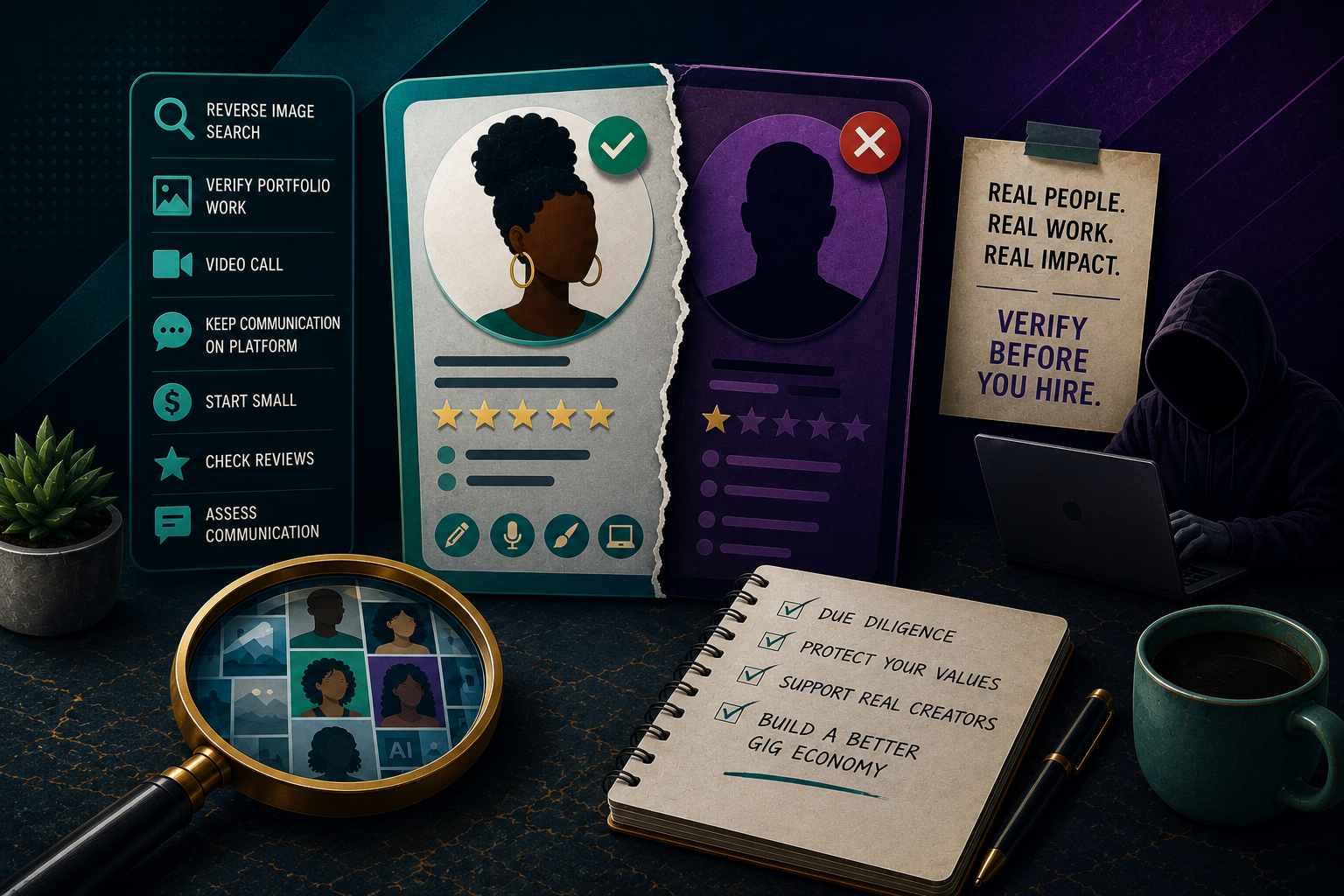
Profile Misrepresentation in the Gig Economy
Freelance gig platforms have become a permanent fixture in the modern economy. In 2025, entrepreneurs, small business owners, and solopreneurs spent over $4 billion on services across platforms like Fiverr and Upwork, marketplaces that together serve millions of buyers worldwide.
For the Creative, Artisan, and Maker community, these platforms represent a reliable source of professional support. Graphic designers, podcast editors, book cover artists, and social media managers are among the most sought-after service providers on both platforms. The appeal is straightforward: a global marketplace of talent, visible portfolios, and competitive pricing in a single destination.
What is less visible is an increasing practice of service providers constructing profiles using images of women, people of color, or other demographic groups to which they do not belong. The profile photo is not accidental. It is a deliberate marketing decision designed to attract buyers from specific communities by manufacturing a false sense of shared identity.
This practice is Profile Misrepresentation. It is also known as Professional Catfishing, Gig Catfishing, Synthetic Identity Fraud, Blackfishing, and Digital Blackface. The names vary depending on a specific industry’s description however; the act is the same regardless of what it is called.
Why does this matter? Because buyers in the Creative, Artisan, and Maker community do not make hiring decisions based on price alone. They make decisions based on values. A buyer who prioritizes supporting Black-owned businesses is making an intentional choice when selecting a provider who presents as a Black business owner. A buyer who wants to hire within the handmade and maker community is placing trust in a shared identity and shared understanding. A buyer who specifically seeks out a woman-owned creative operation is directing money and opportunity toward someone they believe represents that value.
The distinction worth naming is this: there is a fundamental difference between a provider who performs an identity to capture a niche market and one who actually is that identity. Performance is a transaction. Authenticity is the real thing. Profile Misrepresentation collapses that distinction deliberately and profits from the confusion.
When a profile misrepresents that identity, the transaction does not just fall short on honesty. It actively redirects money, opportunity, and trust away from the actual people the buyer was trying to support. The work may get done. The invoice gets paid. But the intentional choice the buyer made never reached its intended destination.
This behavior is present across gig platforms, including but not limited to Fiverr and Upwork, in service categories that directly serve this community. Graphic design, content writing, social media management, podcast editing, video production, and book cover design are among the categories where this pattern appears with regularity. It is not isolated to a single platform or service type. It is a documented pattern across the gig economy.
Profile Misrepresentation is a growing practice in the gig economy, and it is not going away on its own. The platforms where it occurs have been slow to address it in any meaningful way. That does not mean buyers are without recourse. There are deliberate steps any Creative, Artisan, or Maker can take before signing on with a service provider to verify that the person behind the profile is exactly who that profile presents them to be.
Pro Tips: Precautionary Actions Before You Hire
Reverse image search the profile photo. A reverse image search means taking the profile image itself and uploading it, or the link to it, into a search engine to find out where else that image appears across the internet. This takes less than thirty seconds and can reveal whether the image belongs to a stock photo library, another person's social media account, or an AI-generated face. Run this search before making any hiring decisions.
Reverse image search the portfolio work. The same process applies to the work samples in a seller's portfolio. Upload individual portfolio images into a reverse image search tool to find out whether those samples appear elsewhere online under a different name or business. A fabricated profile is frequently paired with a stolen portfolio, and the actual work may belong to an entirely different creator.
Request a brief video call before any money is exchanged. Most gig platforms, including Fiverr and Upwork, have video calling built directly into their systems at no additional cost to either party. Use it. A legitimate service provider with nothing to hide will have no objection to a short introductory call. Reluctance to appear on camera is a signal worth taking seriously.
Keep all communication inside the platform. Every message exchanged within the platform is documented and accessible if a dispute arises. That paper trail has value. Be cautious of any seller who attempts to move the conversation to personal email, WhatsApp, or any outside channel early in the process. That is a known tactic among bad actors who prefer to operate outside of documented, platform-monitored exchanges.
Start with a small paid test project. Before committing to a larger scope of work, assign a limited task first. This provides a real sample of the seller's actual abilities without significant financial exposure.
Read the reviews carefully and look for patterns. A cluster of five-star reviews posted within a short window of time, particularly on a newer account, can indicate manufactured feedback. Detailed and specific reviews carry more weight than generic praise.
Pay attention to communication quality. If the written communication in messages does not align with the professional presentation of the profile, that disconnect deserves attention before any commitment is made.
No platform currently guarantees the authenticity of the identities behind its profiles. That is a systemic failure, and the responsibility for meaningful change ultimately rests with the platforms themselves. Until that changes, the burden of vetting rests with the buyer. These approaches will not eliminate every risk, but they will significantly reduce exposure to Profile Misrepresentation in the gig economy.
