The Weaponization of Sympathy
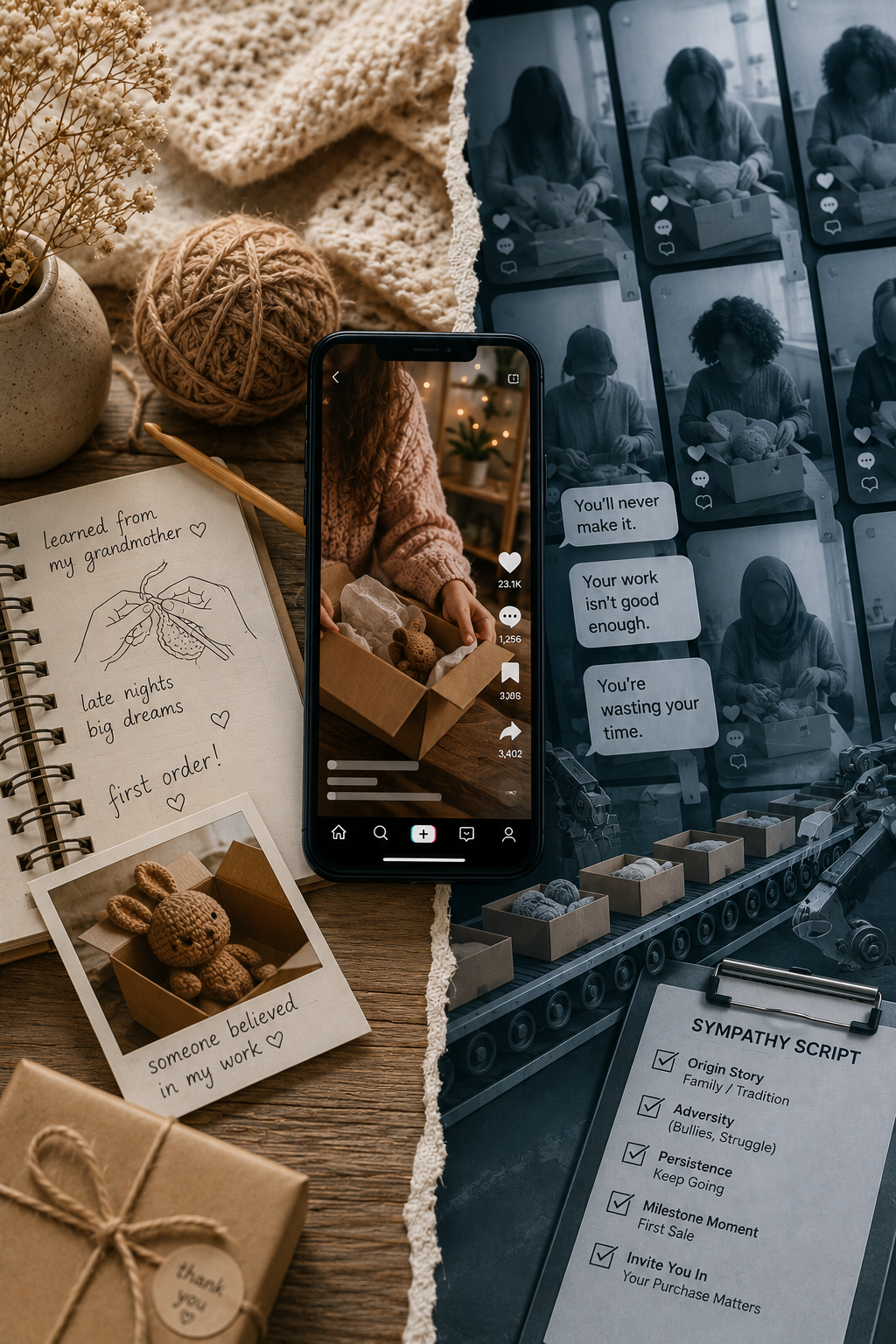
Has this ever happened to you?
You are scrolling through your social media feed when a video stops you. A teenager is talking about how she learned to crochet from her grandmother. She talks about what it means to her, how she struggled to be taken seriously, and how people laughed at her when she set up at her first vendor fair. There are screenshots of text messages — people telling her she would never make it, that her work was not good enough, that she was wasting her time. But she kept going. She turned her craft into a business, and now she is sharing that journey with anyone who will listen. You watch more of her videos. You see the one where she gets her first order and can barely contain her excitement. You see the one where she is carefully packing that order, talking about how much it means that someone believed in her enough to buy. By the time you check out, you are not just buying a product. You are proving the bullies wrong and you are investing in the success of a dream.
Then a few days later, maybe even a few hours later, your feed serves up another video. Different face, different life, different world. But the same craft, the same origin story, the same bullying texts, the same careful packing. The same dream you were invited to believe and trust.
That is not a coincidence. That is a script. And the handmade product at the center of it may be the least handmade thing about the whole operation.
What you experienced has a name. It is the Weaponization of Sympathy, and it is becoming one of the most calculated manipulation tools in digital marketing today.
It Is Not New. It Is Just Scaled.
Emotional marketing is not a new concept. Brands have always understood that people buy with their feelings and justify with logic afterward. What is different now is the precision with which that emotional response is being engineered, and the scale at which a single formula can be deployed across dozens of accounts simultaneously.
The sympathy-bait formula follows a recognizable structure. There is an origin story rooted in family or tradition. There is adversity, ridicule, doubt, financial struggle. There is persistence against the odds. There is a milestone moment, usually the first sale, framed as validation. Each element is there for a reason. The family connection creates warmth. The bullying creates indignation. The persistence creates admiration. The first sale creates the feeling that your purchase matters to a real person's real life and if is really spinning on the emotions wheel their well-being.
The problem is not that the story is emotional. People have always responded to stories of struggle and perseverance, and there is nothing wrong with that. The problem is what happens to the consumer and to the legitimate handmade community when that response is systematically exploited.
The Handmade Community Is Not a Backdrop
The sympathy formula did not land randomly in the handmade and craft space. It landed there deliberately, because that community was already built on something real. Independent makers, artists, and small business owners have spent years cultivating an audience that values human craft, genuine process, and the story behind the object. That trust was earned slowly, through transparency, consistency, and actual skill.
The sympathy-bait operation borrows that trust without earning it. It wraps a manufactured narrative around what is often a mass-produced or drop shipped product, and it uses the language and visual cues of the handmade world, the packing videos, the process shots, the personal milestones, to pass itself off as something genuine. The grandmother who passed down the craft, the late nights perfecting the technique, the pride in the handwork, these become the language of an algorithm, not the memory of a person.
This is not generic emotional marketing. It is a specific infiltration of a community that was built on the premise that what you see is what someone actually made.
The Tax No One Talks About
The cost of this practice to authentic makers is significant, and it is one that rarely gets named directly.
When sympathy-bait content floods a space, it poisons the well for everyone operating honestly within it. The legitimate maker who posts a packing video is now performing in the same visual language as the operation running a script. The real origin story reads like a template. The genuine first sale celebration looks like a staged milestone. There is no way to signal authenticity in a space where authenticity has been weaponized as an aesthetic.
And so the burden shifts. Authentic makers now have to do more, more behind the scenes content, more process documentation, more proof that the hands in the video are the hands that made the thing, just to occupy the space they were already working within. That is time, energy, and creative labor spent on legitimacy rather than craft.
But the deeper cost is the one that cannot be recovered through more content. Because on the consumer side, something has already shifted. The person who was manipulated once does not become more careful. They become more closed. They scroll past. They do not distinguish between the real and the fake because the effort of distinguishing no longer feels worthwhile. And that scroll-past lands on every maker in the feed, regardless of whether their story is true.
The authentic handmade community is not losing customers to these operations one purchase at a time. They are losing the attention of an audience that has simply checked out.
