From Dear Diary to Ephemera and Washi Tape
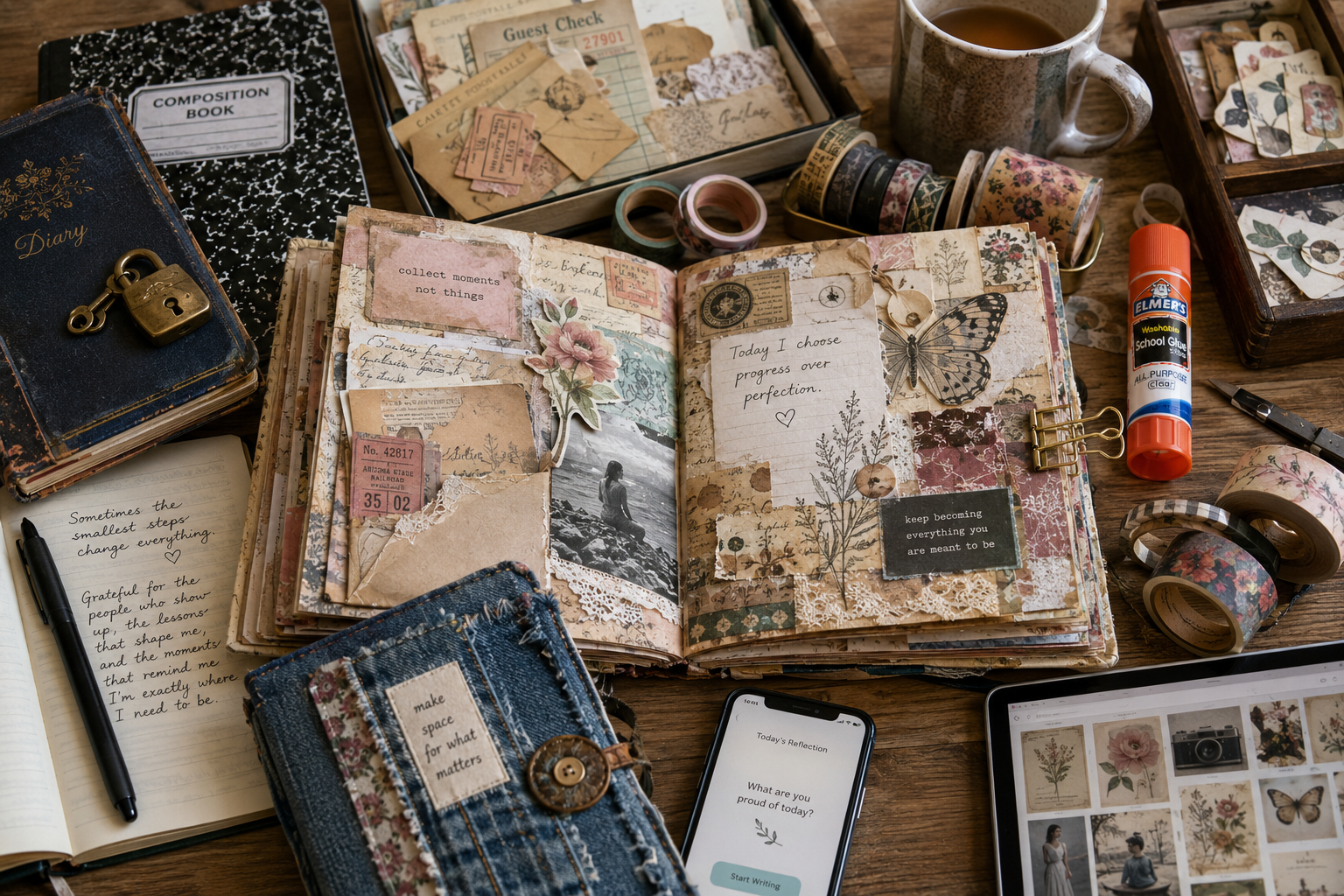
Somewhere in the world right now, someone is carefully tearing the edges of a vintage envelope, swiping a glue stick across a page, and pressing a printed AI-generated image into a hand-decorated journal that tells the story of exactly where they are in life at this moment. This is journaling in 2026. And if that sentence would have meant absolutely nothing to the girl who once hid her diary under a mattress, that is precisely the point.
Where Journaling Lives Now
Stumbling into the creative journaling community for the first time is a specific kind of experience. It does not matter how long a person has been a crafter, a maker, or a creative of any kind. The first encounter with this world has a way of stopping people mid-scroll and prompting one very honest question: what exactly am I looking at?
The terminology alone requires some adjustment. Ephemera. Spreads. Washi tape. Smash books. Then there is the “junk” journal, which, for the record, is one of the more misleading names in the entire creative space. Nothing about a thoughtfully constructed junk journal looks like junk. These are layered, textured, handmade objects built from materials that would otherwise be discarded — vintage envelopes, old ledger pages, clothing tags, tea bags, newspaper clippings, and paper packaging. The finished product looks far more like a handcrafted artifact than anything the word junk would suggest. The name has simply not caught up with what the practice actually produces.
What makes the first encounter more complicated is that not everything traveling under the creative journaling label represents the same level of craft. A significant portion of what surfaces first on social media relies primarily on AI-generated illustrations printed and arranged on a distressed background. The result is visually striking and clearly resonates with a large audience. For someone whose creative identity is rooted in hands-on making, however, it can read more like curation than creation. And if that is the first version of creative journaling a person sees, they might walk away before finding the version that reflects the full depth of the practice. The version rooted in genuine hands-on making looks nothing like what surfaces first on social media. It is built from real mixed media — paint, collage, handwriting, found objects, card stock, stickers, and AI-generated elements used with genuine creative intention. The journal cover itself is part of the creative project, wrapped in denim or painted by hand or constructed from layered paper rather than purchased ready-made. Once a person finds that corner of the community, the whole practice looks completely different.
Creative journaling today does not happen in isolation or in private. It shows up at watch parties, on cruise ships, at community gatherings, and in online groups built entirely around the shared practice of making. People are journaling through milestones, through loss, through travel, and through ordinary weeks that deserve to be documented. The journal has become a vehicle for whatever the moment calls for, and the community that has formed around it reflects that range entirely.
Whence We Came
To appreciate how far journaling has evolved, it helps to go back to where it started. For most people of a certain generation, it started with a small book, a brass lock, and a key.
The lock was not decorative. It enforced the foundational premise of the entire practice — what went on these pages belonged to no one else. Not a parent, not a sibling, not a best friend. Some versions arrived with "Dear Diary" already printed at the top of each page, which meant the writer did not have to decide how to begin. The book decided for her. Thoughts, observations, and the events of the day were recorded in whatever handwriting a ten- or twelve-year-old could produce. The diary was a private covenant, and the lock was the seal on that covenant. There were no images. No decoration. No ephemera. Just the writing and the absolute privacy surrounding it.
The word journaling eventually entered the cultural conversation carrying a different weight than diary ever did. Journaling was therapeutic. It was intentional. Mental health practitioners recommended it. Wellness culture absorbed it. The journal became a tool for self-examination, not just a record of what happened, but a space to process thoughts and feelings. The two words — diary and journal — were often used interchangeably, but the relationship each one created with the page was meaningfully different. The diary documented. The journal reflected.
As the practice grew, so did the format. The composition notebook, recognizable by its black and white marbled cover, crossed from academic utility into everyday creative use. It was affordable, durable, and universally accessible. It also carried none of the secrecy of the lock-and-key diary. A composition notebook could sit on a desk. A teacher could ask to see it. A therapist could review it. Writing down thoughts and observations was becoming, slowly and quietly, less private. The elevated paper journal continued that progression, repositioning the notebook as a deliberate lifestyle choice. Premium paper, thoughtful cover design, and dotted grids gave rise to entire organizational systems and dedicated communities. The journal was no longer a hidden object. It was a public expression of identity chosen with intention.
Digital journaling arrived next as a logical progression. Password protection replaced the brass lock. A document on a computer offered unlimited space and the ability to search across years of entries. For some people it worked well. For others the screen introduced a disconnect between thought and page that the keyboard could not resolve. Voice journaling on the other hand offered a different path, allowing people to speak their entries rather than write them. AI-powered journaling applications have since taken that further still, analyzing entries for emotional patterns and generating personalized prompts based on what the writing reveals. The journal in these applications is no longer a passive container. It participates in the process in ways the brass-locked diary never anticipated.
A Creative Reflection
Through all of that evolution, one thing remained consistent. The impulse to capture experience on a page never went away. What changed was everything surrounding it — the tools, the format, the community, and the relationship between the journal and the world outside it.
The creative journaling community did not turn away from digital tools to build this world. It built this world using them. AI, digital cutting machines, downloadable printables, and social platforms are all part of the creative pipeline that feeds the physical journal. A maker today may spend as much time in a digital workspace scaling imagery and sourcing content as at a table with paper and glue. The physical journal is the destination. The digital world is what feeds it. These two things are partners, and the creative journaling community built that partnership deliberately and fluently.
What grew up around those tools is a community as varied as the journals it produces. Some people are constructing handmade books from scratch, binding their own pages and engineering their own covers. Others are repurposing photo albums, sketchbooks, and found objects into something entirely new. Some are journaling alone. Others are doing it in groups, at events, in online communities that span time zones and creative traditions. A Knicks watch party becomes a journaling event. A cruise becomes a creative retreat. A season of grief, a cross-country move, a new chapter — all of it becomes material for the page.
Journaling began as the most private act a person could commit to paper. It was sealed, hidden, and written for no one but the writer. What it has become is something far more expansive — a creative practice that holds personal reflection, artistic expression, community connection, and lived experience all at once. The brass lock is long gone. What replaced it is an open invitation to document life in whatever form feels most true. Whether a person relates to the girl with the Dear Diary, the maker with the glue stick, or someone still figuring out where they fit in this world, the page has always been waiting. It still is.
