The Diary of an Unapologetic Stasher
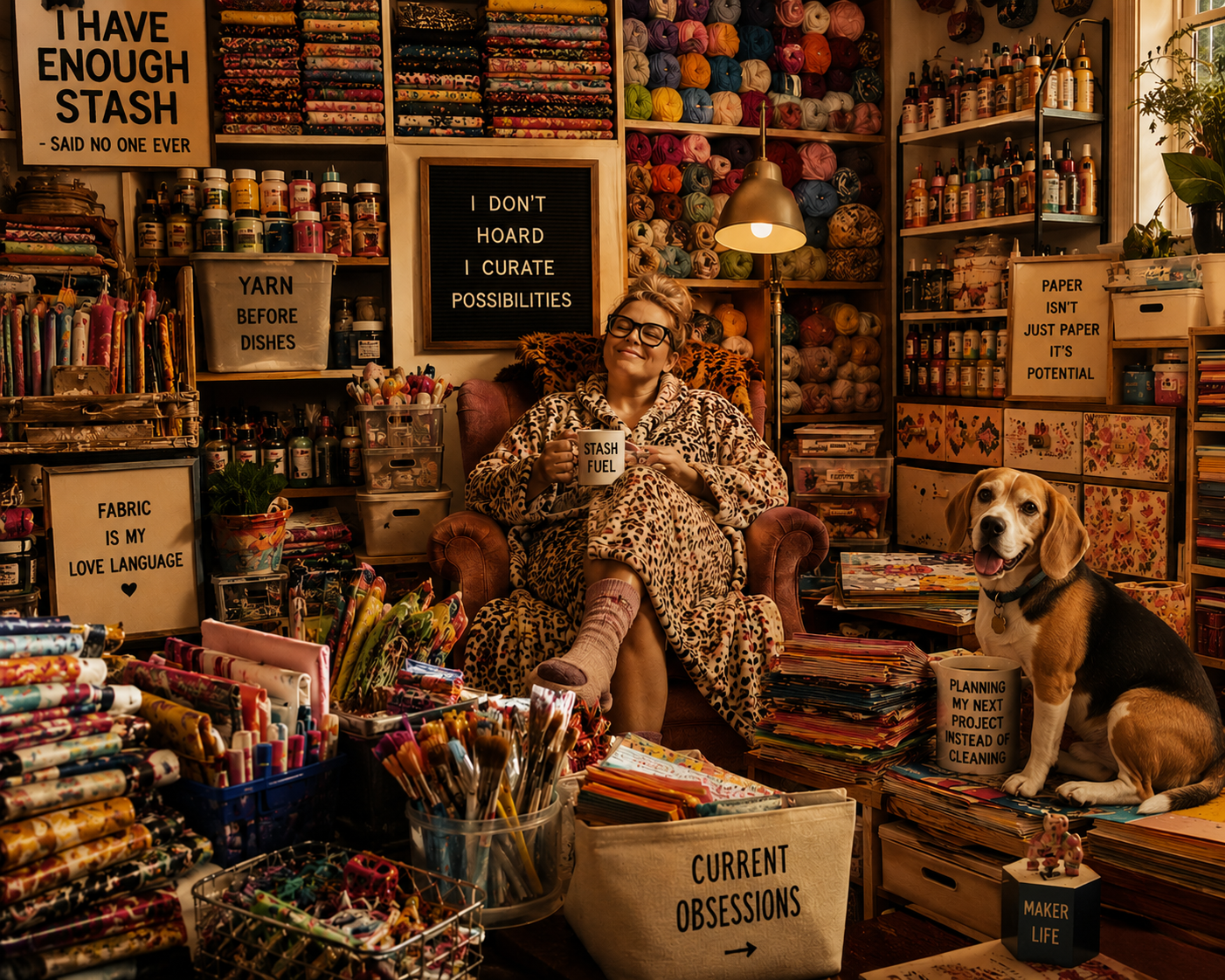
Let me be honest with you. I have a fabric stash. Every piece in it has a name, meaning I already know what it is going to become. I do not need more fabric. I especially do not need more knit. I tell myself this regularly.
And then I go window shopping.
It starts innocently enough. A quick visit to my favorite online fabric stores, just to look. I browse the new arrivals first, and then somehow I find myself in the clearance and sale section. And that is where it happens. A knit catches my eye. The pattern is right. The color is right. The price is somewhere between one and nine dollars a yard, which is my personal threshold for fabric that is too good to walk away from. So I add it to my wish list.
I tell myself the wish list is not a cart. It is just a holding place. A maybe.
But I go back to it. I always go back to it. By the time I am looking at it again, I have already decided what it wants to be. Lounge pants, maybe. Or a relaxed top for spring, if the weight is right for it. The justification writes itself, and before long that maybe has become a purchase.
The part that catches me every time is not the buying. It is what happens after. The purchase itself feels completely reasonable in the moment. But the day that fabric arrives and goes into the stash, the stash I have been telling myself I do not need to add to, that is when the guilt shows up. Not regret exactly. Just the quiet acknowledgment that I did the thing I said I was not going to do. Again.
SURELY IT'S NOT JUST ME…RIGHT?
Somewhere in that cycle, the browsing, the finding, the justifying, the buying, the guilty adding, lives a story that almost every maker in the Creative Artisan and Maker (CAM) community knows by heart. The supply changes. The internal monologue does not.
Because this is not a fabric problem. The woodworker who cannot pass a lumber sale has the same conversation with himself. The knitter who spots a hand-dyed colorway that will never exist again adds it to her cart before she finishes reading the description. The painter who already has seventeen tubes of cadmium yellow picks up one more because that particular shade hits differently in the light. The paper crafter who does not need another pad of watercolor paper, the ceramicist eyeing a new glaze, the resin artist with three unopened bottles of pigment already on the shelf, every one of them has a stash, and every one of them has a reason why the most recent addition was completely justified.
The CAM community has even given this behavior its own language. A stash is not clutter. It is not excess. It is a curated collection of creative possibility, organized by craft, by color, by season, and sometimes by the elaborate future project that exists only in the mind of its owner. There is an entire vocabulary built around it, stash busting, stash building, a yarn diet, a fabric fast, which tells you everything you need to know about how seriously makers take both the accumulation and the occasional, largely unsuccessful attempt to stop.
So who does this? The honest answer is almost everyone who has been making long enough to move past kits. Beginners tend to buy pre-packaged, pre-measured sets that come with exactly what the project requires and nothing extra. The moment a maker starts sourcing independently, choosing their own fabrics, their own fibers, their own materials, the guardrails come off. That is when the stash begins.
BLAME IT ON….
Several triggers drive this behavior, and they tend to work together in ways that are genuinely difficult to resist, even when you know exactly what is happening. Price is the most obvious one. A sale creates what consumer behavior researchers call the illusion of savings. The moment a discount appears, the mental question shifts from whether the item is needed to whether the deal is too good to pass up. The answer to the second question is almost always yes. Flash sales, clearance sections, and limited-time offers do not just move inventory. They move inventory into stashes.
Color and aesthetic appeal work differently but just as effectively. There is actual neurobiological research behind the experience of seeing a fabric print or a color and texture that stops you mid-scroll. The visual trigger releases dopamine before a single practical thought has a chance to form. By the time the rational brain catches up, the item is already in the wish list.
Then there is the scarcity factor. Independent designers, boutique dye houses, small fabric mills, and specialty paper makers produce limited runs that do not get repeated. When a maker knows that a particular print or material will disappear permanently, the calculus changes entirely. Buying becomes a form of preservation. The fear of missing out is not irrational in a market where missing out is genuinely permanent.
Then there is the specialty factor, which is the one that gets most makers the deepest. Once a crafter develops a strong preference for a specific material, knit fabrics, hand-dyed merino, a particular weight of watercolor paper, a specific clay body, purchasing within that specialty stops feeling like shopping and starts feeling like collecting. The stash is not viewed as unused excess. It is viewed as a palette, a resource, an inventory of creative options that reflects who you are as a maker.
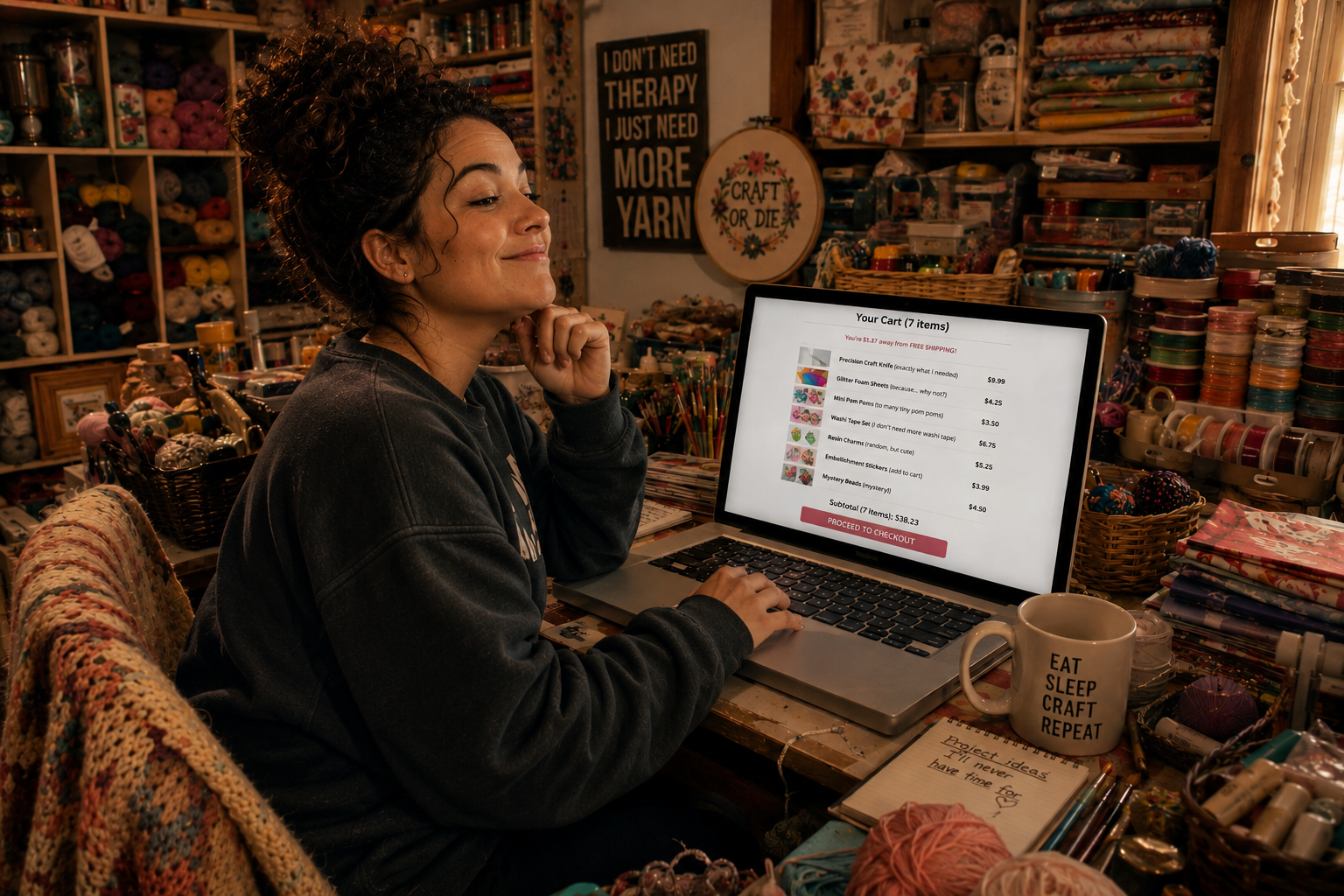
There is also the checkout problem, which deserves its own moment of honesty. According to the Baymard Institute, 48% of online shopping carts are abandoned because of unexpected shipping costs. Retailers responded by creating free shipping thresholds, and makers do the math in real time. You came for one thing. You are now a dollar and change away from free shipping. Because free shipping is already included with your account at your preferred retailer, the barrier to that seventh item is essentially zero. The cart fills. The transaction feels like a win. The stash grows.
Platform loyalty quietly shapes this too. A maker with free shipping at a particular retailer will return there again and again, not only because the selection is strong but because the barrier to purchase is lower. A flat shipping fee at another store, regardless of how good the fabric or the fiber might be, creates just enough friction to send the browser back somewhere more frictionless. The $9.99 shipping fee is not just an inconvenience. For many makers, it is the one thing standing between a manageable stash and a significantly larger one.
All of this buying eventually lands somewhere, and that somewhere is the stash. Once something arrives, a different dynamic takes over. Consumer psychologists refer to this as the endowment effect, the tendency to assign significantly more value to something simply because you own it. That fabric purchased on sale for seven dollars a yard is now, psychologically, worth considerably more. Which means it cannot be used on just any project. It needs the right project, the one that does full justice to what that fabric actually deserves.
That project has a way of never quite arriving. So the fabric waits. The yarn waits. The specialty paper waits. In the meantime, more joins it.
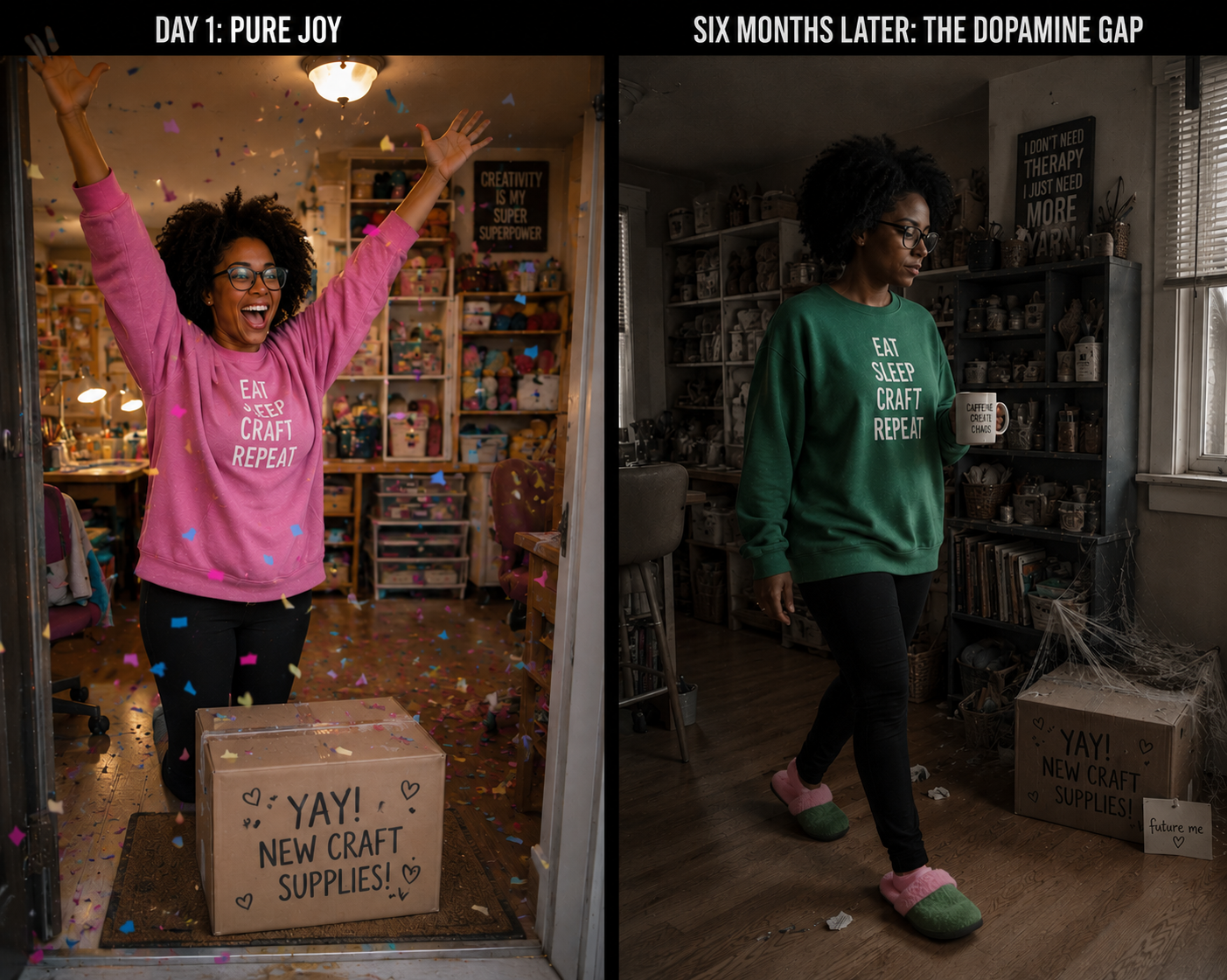
Researchers who study consumer behavior and creative psychology have named the gap between the satisfaction of acquiring and the reality of making. The dopamine released during the hunt, the find, and the purchase is frequently higher than what arrives during the actual act of making. Buying is immediate and satisfying. Making is slow, requires effort, and carries the very real possibility of things not turning out the way they looked in your head. The stash grows partly because acquisition outpaces execution almost by design. The brain rewards the shopping more reliably than it rewards the sitting down to actually do the thing.
STASHING IS A LOVE LANGUAGE

The global arts and crafts market was valued at approximately $47 billion in 2025. That is not a market built on people buying only what they need for their current project. That is a market built on possibility, on the next idea, on the color or print that was too good to leave behind, and on the very human impulse to keep the creative options open.
So no, the stash dilemma is probably not going to get resolved. Not because makers lack awareness, most are keenly aware of exactly what they are doing and fully capable of narrating every step of the justification process in real time. It will not get resolved because for most makers, it does not actually need to be. The stash is the natural condition of a creative life maintained by someone who loves their craft enough to keep investing in it, even before they know exactly what comes next.
The only real question is whether you have enough storage. And whether that new knit is still sitting in the wish list.
